Made in America, Priced to Win: How Domestic Cotton Mills Are Beating Overseas Factories at Their Own Game
For a long time, the story wrote itself: American mills were the expensive option. Overseas factories — first in Japan, then China, then Vietnam, Bangladesh, and beyond — kept underercutting domestic producers on price, and brands followed the cheapest bid without much hesitation. Entire textile communities hollowed out. Mill towns went quiet. And the idea that "Made in USA" was a luxury designation rather than a practical choice became deeply embedded in how the industry thought about itself.
That story is getting rewritten right now, and it's happening faster than most people realize.
The Cost Equation Has Shifted — Quietly and Dramatically
Here's what changed: it wasn't one thing. It was everything at once.
Wage growth in manufacturing hubs like China and Bangladesh has been climbing steadily for over a decade. Shipping costs spiked to historic highs during the pandemic and haven't fully returned to pre-2020 levels. Lead times from overseas suppliers — once a manageable inconvenience — became a genuine liability when global supply chains seized up and brands found themselves either drowning in inventory or staring at empty shelves. Add in rising tariffs, increased compliance costs around labor and environmental standards, and the math that once made overseas production a no-brainer started looking a lot less obvious.
Meanwhile, American mills weren't standing still.
"People assume our facilities look like something out of the 1950s," says one production manager at a North Carolina spinning operation that's been running since 1987. "We've put serious capital into automation over the last ten years. Our output per labor hour is genuinely competitive with anything overseas. The gap that used to exist just isn't there the way it was."
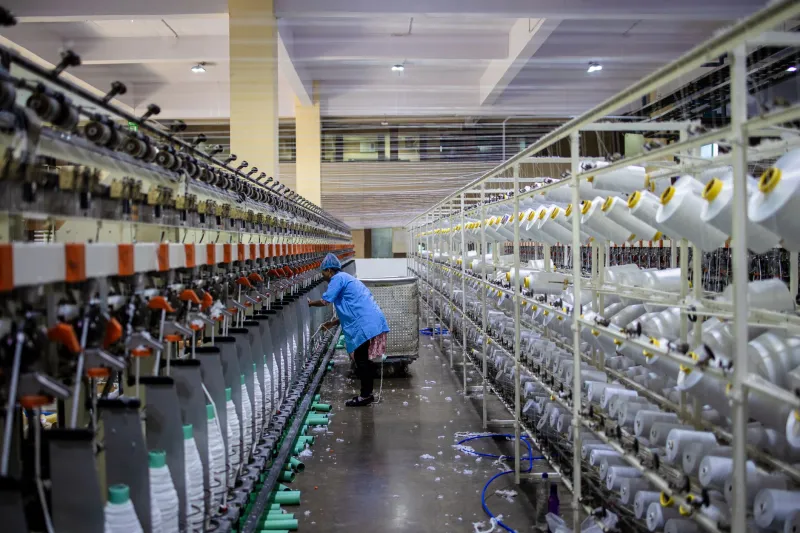
That investment in automation is a recurring theme when you talk to domestic manufacturers. Modern American cotton mills are running sophisticated ring-spinning and open-end spinning equipment, computerized quality-control systems, and real-time inventory management tools that would have been unimaginable even fifteen years ago. The result is a leaner, faster, more precise operation — one that can turn around orders in weeks rather than months.
Speed Is the New Currency
If there's a single competitive advantage that domestic mills keep coming back to, it's speed-to-market.
Fast fashion trained consumers to expect rapid inventory turnover. But it also trained brands to expect rapid replenishment, and that's where overseas manufacturing has always had a structural weakness. A six-to-nine-month lead time from an overseas supplier is a gamble. You're betting on what consumers will want nearly a year from now, ordering in bulk, and hoping the trend doesn't peak before the shipment clears customs.
Domestic mills can cut that timeline dramatically. Several U.S. producers are now offering four-to-eight week lead times on standard orders — and some have built responsive manufacturing setups that can fulfill smaller, more frequent runs without a cost penalty. For brands that want to test new colorways, respond to trending styles, or simply keep their inventory lean, that flexibility is worth a significant premium. In many cases, though, they're not even paying a premium anymore.
"We had a brand come back to us after seven years overseas," says the owner of a Georgia-based fabric mill. "They did the full calculation — shipping, tariffs, quality control trips, the cost of the inventory they had to write off when a style didn't sell — and we were actually cheaper on a total-cost basis. Not close. Cheaper."
Quality Control You Can Actually Control
There's another cost that rarely shows up in the initial price comparison: defects.
Overseas manufacturing, even at reputable facilities, involves a degree of quality variability that domestic production largely eliminates. When your mill is a three-hour drive away instead of a fourteen-hour flight, oversight is a fundamentally different proposition. Brands working with American mills describe being able to visit facilities on short notice, catch problems early in the production run, and maintain a consistency of output that overseas suppliers — regardless of their intentions — often struggle to match.
For cotton specifically, domestic sourcing adds another layer of quality assurance. American-grown cotton, primarily out of the Southeast and the Texas High Plains, is subject to strict agricultural standards and is processed under consistent conditions. The fiber quality is well-documented and reliably traceable. That matters more than it used to, both because consumers are increasingly asking for transparency and because brands have learned the hard way that inconsistent raw material leads to inconsistent finished goods.
Reshoring Isn't a PR Move Anymore
For a while, brands that brought manufacturing back to the U.S. made a point of announcing it. It was a marketing story, a premium positioning play, a way to charge more and feel good about it. That dynamic hasn't disappeared entirely, but something more pragmatic is now driving the reshoring conversation.
Multinational brands — the kind that once built their entire sourcing strategy around low-cost offshore production — are quietly, without press releases, moving portions of their supply chains back to domestic mills. Not because it looks good. Because it pencils out.
"We're not getting calls from brands who want to slap a 'Made in USA' label on something and charge double," says a sales director at a South Carolina weaving facility. "We're getting calls from brands who got burned on lead times or quality or both, and they want a solution. The American-made story is a bonus. The business case is the reason."
That shift in motivation matters. When reshoring is driven by genuine operational logic rather than marketing optics, it tends to stick. Brands don't reverse course on sourcing decisions that are saving them money and headaches.
The Infrastructure Is Rebuilding Itself
One underappreciated factor in all of this is the ecosystem effect. As more production returns to domestic mills, the supporting infrastructure — dyehouses, finishing facilities, cut-and-sew operations — becomes more robust. A stronger domestic supply chain makes it easier and more cost-effective for the next brand to reshore, which strengthens the ecosystem further.
It's a virtuous cycle, and it's been building quietly for several years. The towns that were defined by textile manufacturing a generation ago are seeing cautious but real signs of reinvestment. New equipment, new hires, new capacity.
None of this means overseas manufacturing is going away. Global supply chains are too complex and too entrenched for that. But the era of reflexive offshoring — of treating domestic production as automatically uncompetitive — is ending. American cotton mills have done the hard work of modernizing, and the numbers are starting to reflect it.
The comeback isn't a feel-good story anymore. It's a business story. And business stories, when the math is right, have a way of rewriting the conventional wisdom for good.