Skin Deep: The Surprising Link Between Synthetic Fabrics and America's Itching Epidemic
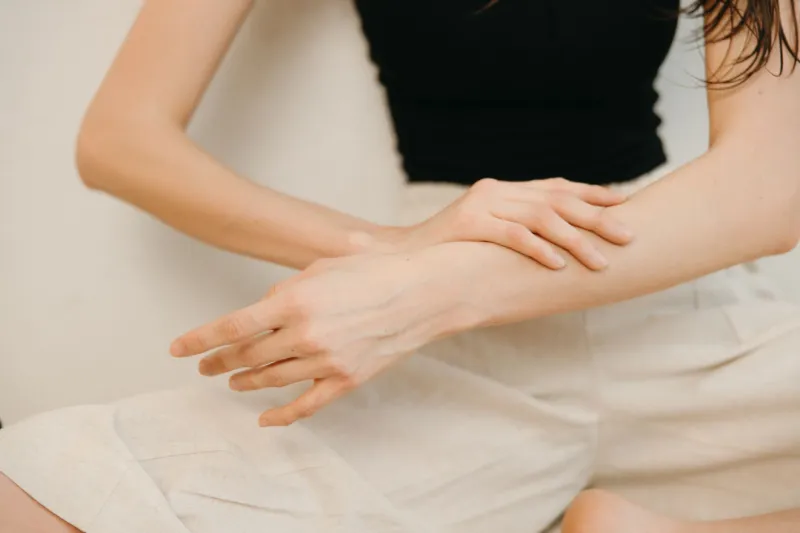
Somewhere between the fifth hydrocortisone prescription and the third "just try a different detergent" suggestion, Melissa R. from Columbus, Ohio, started wondering if the problem wasn't her laundry room — it was her closet.
"I had this persistent rash on my torso and inner arms for almost two years," she says. "Doctors kept telling me it was eczema, or stress, or my soap. Nobody once asked me what I was wearing."
When a friend suggested she try switching to 100% cotton basics, Melissa was skeptical. Three weeks later, the rash she'd been chasing with prescriptions for 24 months had mostly faded. She's not alone — not by a long shot.
The Itch Nobody Wants to Talk About
Contact dermatitis — a catch-all term for skin inflammation triggered by direct contact with an irritant or allergen — is one of the most underreported and misdiagnosed conditions in the United States. The American Academy of Dermatology estimates that it affects roughly 15 to 20 percent of the general population at any given time. And while the usual suspects (nickel jewelry, latex, certain cosmetics) get most of the attention, textiles are quietly climbing the list.
Dr. Patricia Wahl, a board-certified dermatologist practicing in suburban Chicago, says she's noticed a pattern over the last decade that she can't ignore anymore.
"We're seeing more patients come in with reactions that are clearly fabric-related," she explains. "The distribution of the rash — the way it follows the neckline of a shirt, or clusters where a waistband sits — is a dead giveaway. And when we patch-test these patients, we're finding sensitivities to specific synthetic compounds."
The compounds she's referring to include formaldehyde-based resins used to make fabrics wrinkle-resistant, disperse dyes commonly applied to polyester and nylon, and finishing chemicals designed to give synthetic blends that smooth, silky feel. Many of these substances are approved for use in textiles but were never specifically evaluated for prolonged skin contact — which is, of course, exactly how clothing works.
Polyester's Dirty Little Secret
Here's something the fast fashion industry doesn't put on a hang tag: a significant portion of the synthetic clothing sold in the US is treated with a rotating roster of chemical finishes that help the fabric look better in the store, ship more easily, and hold its shape on a hanger. Some of those finishes are benign. Others are not.
Formaldehyde resins, for example, are used widely in wrinkle-free and moisture-wicking garments. The EPA classifies formaldehyde as a known carcinogen, and yet it remains legal in textile finishes with no required disclosure to consumers. For most people, the levels present in a single shirt are too low to cause acute harm. But for someone wearing synthetic fabrics head to toe, eight to twelve hours a day, five days a week? The cumulative exposure picture looks very different.
Disperse dyes — the colorants most commonly used on polyester — are another growing concern. These dyes don't bond chemically to synthetic fibers the way reactive dyes bond to cotton. Instead, they sit in the fiber structure and can migrate out with heat and friction, transferring directly to skin. Allergic reactions to disperse dyes are well-documented in dermatology literature, and yet most consumers have never heard of them.
"The textile industry has always had a bit of a transparency problem," says Dr. Wahl. "There's very little obligation to disclose what's been done to a fabric between the mill and the store shelf."
Why Cotton Breathes Different — Literally
Pure cotton — especially American-grown cotton, which is subject to stricter agricultural oversight than many imported alternatives — starts from a fundamentally different place. The fiber itself is a natural cellulose structure. It doesn't require the same category of chemical treatments to perform. It breathes, wicks moisture away from the skin through capillary action, and regulates temperature in a way that synthetics simply can't replicate mechanically.
More importantly, cotton accepts reactive dyes that bond at a molecular level. The color becomes part of the fiber rather than a passenger riding along on top of it. That matters for people with sensitive skin, because there's significantly less dye migration with cotton compared to polyester.
None of this means cotton is entirely without risk — some people do have sensitivities to specific cotton finishing treatments, and fabric softeners can introduce their own irritants. But the baseline irritation profile of untreated cotton is dramatically lower than that of most synthetic blends.
For Marcus T. in Atlanta, that difference was immediate and undeniable. He'd been dealing with what his doctor called "occupational dermatitis" for years, attributed to his work environment. When he replaced his synthetic athletic wear with American-made cotton workout gear, the flare-ups stopped.
"My dermatologist was almost annoyed that such a simple switch worked when nothing else had," he laughs. "But she also admitted she probably should have asked about fabrics sooner."
Why Isn't Medicine Connecting These Dots?
It's a fair question. Dermatologists are trained to identify contact dermatitis — so why isn't textile-related skin irritation getting more attention as a mainstream diagnosis?
Part of the answer is systemic. Patch testing for textile allergens is time-consuming and not always covered by insurance. There's also no standardized textile allergen panel in the US the way there is in Europe, where textile contact allergy is taken more seriously as a clinical category. American dermatology guidelines tend to focus on the most common allergens — metals, preservatives, fragrances — and textiles often don't make the short list during a brief office visit.
There's also the issue of delayed reactions. Unlike a bee sting or a food allergy, contact dermatitis from fabric often develops slowly, over days or weeks of repeated exposure. By the time a patient connects the rash to a specific garment, they've often worn it dozens of times and washed it repeatedly, making it harder to isolate as the cause.
"Patients come in frustrated," says Dr. Wahl. "They've already tried eliminating their detergent, their body wash, their dryer sheets. Nobody's told them to look at the fabric content label."
What You Can Actually Do About It
If you've been dealing with unexplained skin irritation, itching, or recurring rashes — especially in areas that correspond to where clothing sits tightest — it's worth doing a simple experiment before reaching for another tube of cortisone cream.
For two to three weeks, swap out your most-worn items (the everyday tees, the workout gear, the underwear) for pieces made from 100% American cotton. Wash them once before wearing. Skip the fabric softener. Pay attention to where and when your symptoms occur.
It's not a clinical trial, but it's the kind of real-world test that many people — like Melissa and Marcus — have found more useful than anything a prescription pad offered.
American-made cotton products carry an added layer of confidence here: domestic manufacturing is subject to labor and safety standards that regulate what finishing chemicals can be used and in what concentrations. That's not a marketing claim — it's a regulatory reality that makes a measurable difference for people with sensitive skin.
The Bottom Line
The itching epidemic sweeping American skin isn't happening in a vacuum. It's happening in the context of a fashion industry that has spent thirty years replacing natural fibers with cheaper, more chemical-dependent synthetics — and a medical system that hasn't fully caught up to the consequences.
Your skin is the largest organ you have. It works hard every single day. Maybe it's time to give it something worth wearing.