Button-Down Revolution: Why American Businesses Are Swapping Synthetic Uniforms for Real Cotton
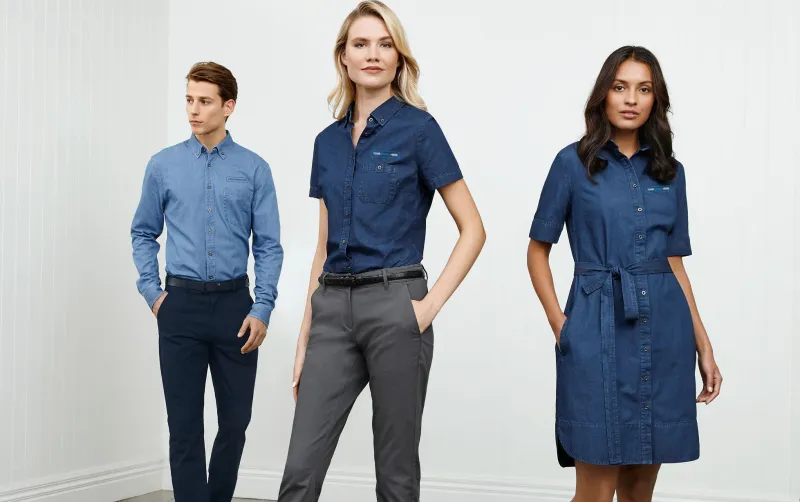
Photo: American business employees in clean cotton uniforms workplace professional setting, via img.paylesspromotions.com.au
It starts with a complaint. Usually from a floor nurse, or a hotel housekeeper, or a customer service rep who spends eight hours on their feet in a polyester-blend uniform. The complaint is always some version of the same thing: I'm uncomfortable all day, and I don't know why.
The answer, increasingly, is the fabric.
And a growing number of American companies — from regional healthcare networks to national hospitality brands — are figuring that out and doing something about it. The switch to American-made cotton uniforms is happening quietly, without press releases or sustainability reports leading the charge. It's being driven by HR managers, facilities directors, and operations teams who are looking at the numbers and making a practical decision.
The Synthetic Uniform Problem
Polyester-blend uniforms became the default in American workwear for reasons that made sense on a spreadsheet: they're cheap to produce, they hold color well, and they resist wrinkles. For a company outfitting hundreds or thousands of employees, those properties translate to lower upfront costs and easier laundry logistics.
What the spreadsheet didn't capture was everything else.
Employees in synthetic uniforms report higher rates of skin irritation, particularly in jobs that involve physical activity or extended outdoor exposure. The moisture-trapping properties of polyester — which keeps sweat on the skin rather than absorbing it — become a significant comfort issue across an eight-hour shift. In healthcare settings, where staff move constantly and temperature regulation is critical, synthetic fabrics can contribute to fatigue and discomfort that accumulates over a full workday.
And then there's the odor issue. Synthetic fabrics harbor bacteria more readily than natural fibers, which means polyester uniforms develop persistent odors faster — a particular concern in customer-facing roles where presentation matters.
Healthcare Is Leading the Shift
The healthcare sector has been among the most proactive in rethinking workwear fabric, and the reasons are both practical and regulatory.
Hospitals and clinical networks operate in environments where staff comfort directly correlates with performance. Nurses and technicians who are physically uncomfortable — itchy, overheated, or dealing with skin irritation — are less focused and more fatigued. Several regional health systems that have piloted cotton uniform programs report measurable improvements in staff satisfaction scores, with fabric comfort cited as a specific positive in employee feedback.
There's also an infection control dimension. While synthetic fabrics don't inherently increase infection risk, the relative resistance of natural cotton fibers to bacterial adhesion is a factor that infection prevention teams have begun to take seriously. American-made cotton scrubs and clinical workwear are increasingly specified in purchasing decisions at hospitals that prioritize evidence-based environmental hygiene practices.
For healthcare workers already navigating high-stress environments, the simple act of wearing something comfortable all day is not a trivial benefit. It's a retention tool.
Hospitality and Service: The Customer Experience Angle
In the hospitality industry, employee presentation is a direct component of the guest experience. A front desk associate in a crisp, well-maintained cotton shirt reads differently than one in a visibly worn synthetic uniform — and that difference is felt by guests even when they can't articulate why.
Several hotel groups operating in the mid-to-luxury segment have moved to American-made cotton for front-of-house uniforms, citing both the aesthetic quality of natural fiber and the practical benefit of longer garment lifespan. Cotton uniforms, when properly cared for, maintain their appearance through significantly more wash cycles than polyester equivalents. That means lower replacement frequency and, over a multi-year uniform program, meaningful cost savings.
For housekeeping and facilities staff — the roles that involve the most physical exertion — the comfort argument is even more compelling. Workers in cotton uniforms report less heat buildup during active tasks and lower rates of the skin irritation that commonly develops under synthetic fabrics worn during strenuous activity.
The Cost Math Over Time
The upfront cost of American-made cotton uniforms is higher than offshore synthetic alternatives. That's a real number, and any business making the switch has to account for it.
But the full cost calculation looks different when you extend the timeline.
A quality American cotton uniform garment, properly maintained, can last two to three times longer than a comparable polyester-blend item. When you factor in replacement frequency, the per-wear cost of cotton often comes out lower over a three-to-five year uniform program cycle. Add in reduced sick-day rates linked to comfort-related fatigue — a softer number but one that HR departments are beginning to track — and the economics shift further.
There's also the domestic sourcing angle. Companies that purchase American-made cotton uniforms can credibly incorporate that decision into their ESG reporting and sustainability communications. In an era when corporate stakeholders — investors, customers, and employees alike — are scrutinizing supply chain claims, the ability to point to verified domestic production has real reputational value.
The Employee Recruitment Dimension
This one is newer, but it's showing up in conversations with HR professionals across industries.
In a tight labor market, the details of a job offer matter more than they used to. Benefits, schedule flexibility, and work environment all factor into a candidate's decision. What employees wear every day is part of that environment — and companies that invest in quality workwear are increasingly using it as a differentiator in recruitment.
"We switched to American cotton for our floor staff and made sure candidates knew about it during interviews," one operations director at a regional restaurant group told us. "It sounds small, but when you're competing for the same pool of applicants as everyone else, anything that signals you actually care about the day-to-day experience matters."
Quiet Pride in American Manufacturing
There's something else happening in these conversations that doesn't show up in cost analyses or employee surveys. Companies that make the switch to American-made cotton uniforms often describe a subtle shift in how the decision feels internally.
Buying American-made isn't just a procurement choice — it's a statement about what a company values. For businesses that employ American workers and operate in American communities, outfitting those workers in domestically produced goods creates a coherence between what the company says and what it does.
That alignment matters more than it might seem. Employees notice. Customers notice. And in a business environment where authenticity is increasingly hard to fake, it turns out that simply doing the right thing — buying quality, buying American, treating your workforce to fabric that actually works — is one of the more effective brand strategies around.
The polyester era of American workwear isn't over. But it's ending. And the companies moving first are already reaping the rewards.